

Digital vs. Physical Games on Xbox: What's Actually Different From PlayStation and Why It Matters Before You Buy
The mistake almost everyone makes when switching platforms
If you've spent years on PlayStation and you're adding an Xbox — or vice versa — it's tempting to assume digital and physical games work the same way on both. Same generation, same era, similar price tags. Why would they be different?
They are. Meaningfully so. And the differences don't show up until you've already bought the wrong thing for how you actually game.
This isn't a "PlayStation is better" or "Xbox is better" post. It's a map of the real structural differences so you can make a genuinely informed decision before spending money on either platform.
The disc situation: not all digital consoles are equal
Both Sony and Microsoft sell disc-less console variants. But the implications aren't the same.
On PlayStation, the Digital Edition is a permanent commitment. There's no disc drive add-on that restores physical game support after the fact — you've chosen a lane. On Xbox, Microsoft has taken a more modular approach with certain console designs, exploring options where a disc drive can be attached separately. That's a meaningful difference for anyone who buys physical games, borrows from friends, or shops used game bins at a local store.
The short version: if you buy a disc-less PlayStation, you are locked into digital purchases and PlayStation's own storefront for every game going forward. On Xbox, depending on the specific model, that door may not be fully closed. Check the exact console model you're buying before assuming either way.
Xbox Play Anywhere — a feature PlayStation doesn't have
This is the one that surprises people the most. Microsoft has a program called Xbox Play Anywhere. Titles that support it give you both the Xbox console version and the Windows PC version in a single purchase. Buy it once digitally, play it on your Xbox and on your Windows PC without paying again.
PlayStation has no direct equivalent. A PS5 digital purchase plays on PS5 (and sometimes PS4 if backward compatibility applies), but it doesn't extend to a PC version. If you game on both a console and a Windows PC, that's a real cost difference over time — not a small one if you buy several Play Anywhere titles a year.
One important caveat: Play Anywhere only applies to participating titles. Not every Xbox game is in the program. Check the game's store page before assuming it qualifies.
Game Pass changes the digital calculus on Xbox — but not in the way people think
Xbox Game Pass (now called Xbox Game Pass Ultimate at its top tier) includes a rotating library of games for a monthly subscription. That's well known. What's less understood is how it affects the decision to buy digital vs. physical on Xbox specifically.
If a game you want is on Game Pass, buying it digitally at full price is often the wrong move — you're already paying for access through the subscription. But if a game leaves the service and you want to keep playing it, you'll need to buy it. Physical copies give you permanent ownership regardless of what happens to any subscription library. Digital purchases you made outright also stay in your library.
PlayStation has PlayStation Plus with its own game catalog, but the depth and day-one release strategy has historically differed from Xbox's approach. Microsoft has been more aggressive about putting first-party titles into Game Pass on or near launch day — meaning a new Xbox exclusive is more likely to be playable through your subscription without a separate purchase than a new PlayStation exclusive would be through PS Plus.
That's not a quality judgment. It's just a structural difference that changes the math on whether to buy or subscribe on each platform.
Resale and lending: physical still wins, but only on one platform
Physical games can be resold, lent to a friend, or traded in. That's true on both platforms. Digital games cannot — once purchased, they're tied to your account.
Where this gets platform-specific: on PlayStation, the used physical game market is robust and has been for decades. On Xbox, the shift toward digital has been more aggressive, and Microsoft's long-term direction has clearly favored a disc-free future. That doesn't mean physical Xbox games are going away tomorrow, but it's worth noting if long-term resale value matters to you.
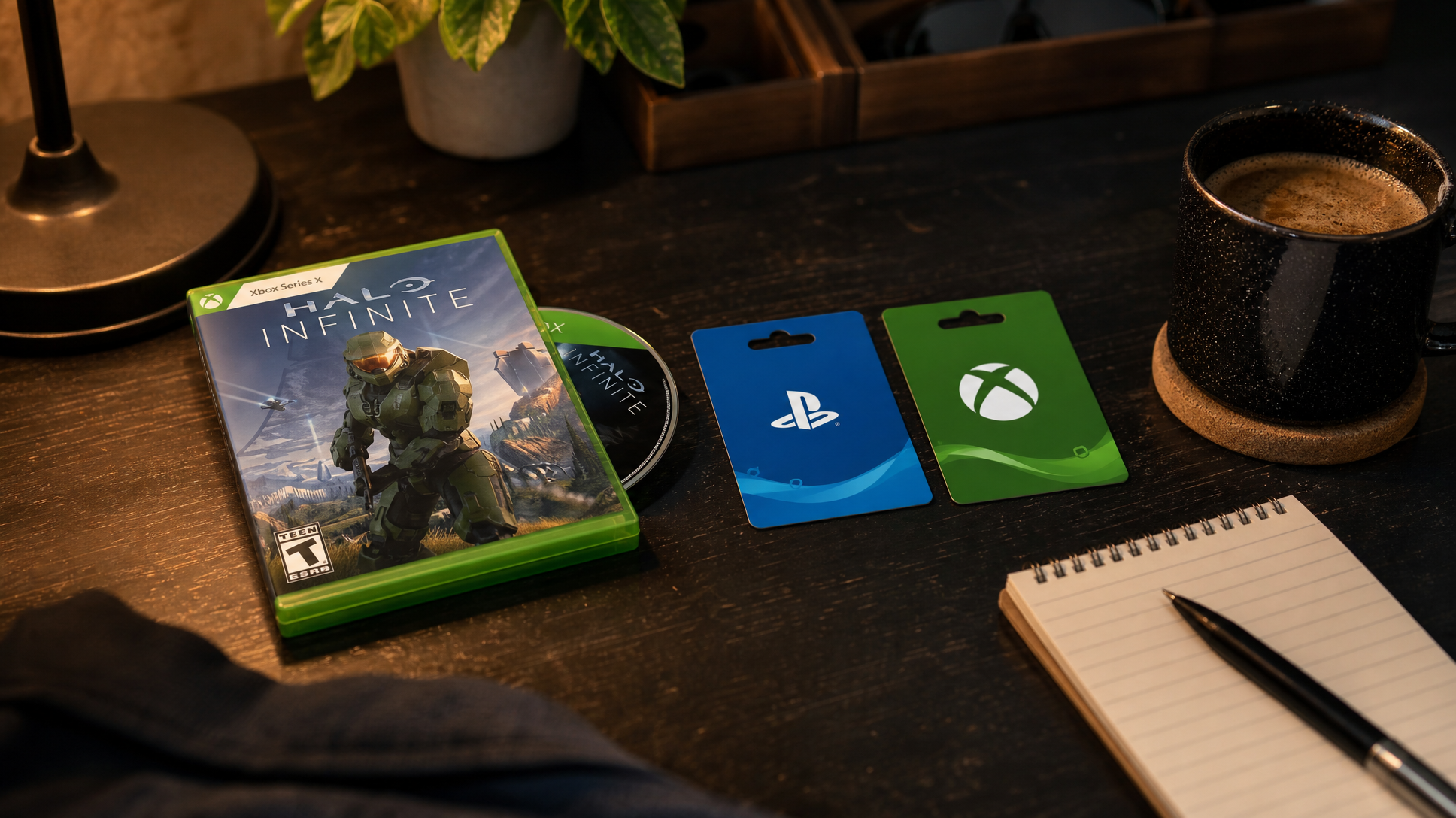
For gift-givers especially, a physical game is almost always the safer choice — it doesn't require knowing the recipient's account details, it can be wrapped, and it doesn't expire. A PlayStation or Xbox gift card is a solid alternative for digital storefronts, giving the recipient the choice without the guesswork.
Regional pricing and storefront differences
Both Xbox and PlayStation digital storefronts run their own sales, and prices don't always move in sync. A game might be 40% off on the PlayStation Store and full price on Xbox the same week, or the other way around. Physical retail pricing tends to be more uniform across platforms since it's set by the retailer.
If you're price-sensitive, physical games — especially slightly older titles — often undercut digital storefront prices significantly. The used market on physical games is something digital simply can't match.
What this means when you're actually buying
Here's the practical version, distilled:
- If you game on both Xbox and a Windows PC, digital purchases on Xbox (specifically Play Anywhere titles) give you more value than the equivalent digital purchase on PlayStation.
- If you have Xbox Game Pass, think twice before buying a new Xbox first-party title digitally at launch — check if it's already in the subscription.
- If you buy a disc-less PlayStation, you're fully committed to digital. That's fine, but go in knowing it.
- If resale or lending matters to you, physical games are the better choice on either platform — but especially on PlayStation where the used game ecosystem is deeper.
- If you're buying a gift, a physical game or a platform gift card sidesteps account-access issues entirely. GameX24 carries both, across PlayStation and Xbox.
Neither digital nor physical is universally better. The right answer depends on which platform, which console model, whether you subscribe to a game service, and how you actually play. The mistake is assuming the answer is the same on both platforms — it isn't.
Shop physical game titles and gift cards for PlayStation and Xbox at GameX24 — one store, both platforms, no guesswork on which storefront to visit.
Frequently Asked Questions
Can I play Xbox digital games on PlayStation, or vice versa?
No. Digital purchases are tied to the platform's own storefront and account ecosystem. An Xbox digital game plays on Xbox consoles and, if it's a Play Anywhere title, on Windows PC — but it has no relationship to a PlayStation account or console, and the same is true in reverse.
Does Xbox Play Anywhere work with physical disc copies?
No. Xbox Play Anywhere only applies to digital purchases of qualifying titles. If you buy a Play Anywhere game on disc, you get the Xbox console version — the PC entitlement is not included. You'd need to purchase it digitally to get both versions.
If a game leaves Xbox Game Pass, do I lose access to it?
Yes — once a title leaves the Game Pass library, you'd need to purchase it separately to keep playing. Games you've bought outright (digitally or physically) are not affected by Game Pass library changes; only the subscription-access copy disappears.
Is a PlayStation or Xbox gift card a good alternative to buying a specific game?
For gifting, yes — it's often the smarter choice. A gift card lets the recipient pick their own title, doesn't require knowing their account details, and works across digital storefronts where they can apply it to sales or pre-orders. Just make sure the card matches the right platform (PlayStation Store vs. Xbox/Microsoft Store), since they're not interchangeable.